Analogue Paneer Explained: Why Maharashtra Banned It and What Consumers Need to Know
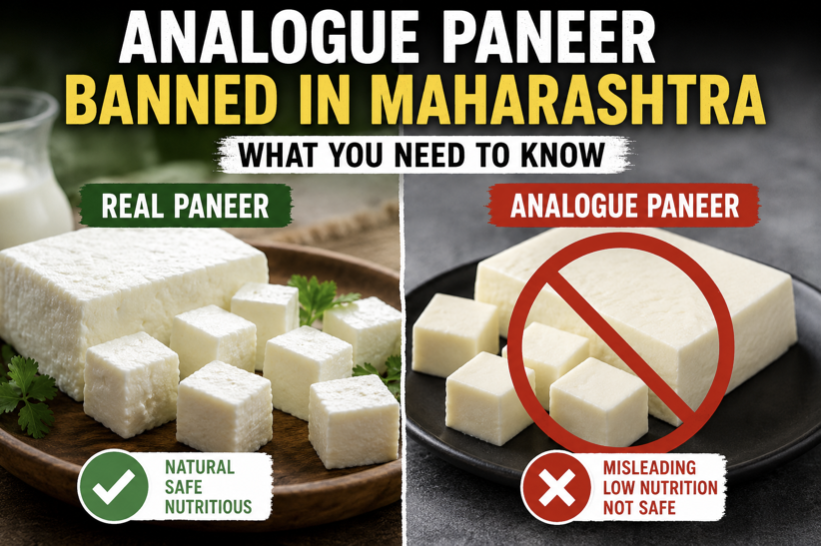
The Government of Maharashtra has imposed a one-year ban on the manufacture, storage, distribution and sale of analogue paneer after the state's Food and Drug Administration (FDA) found widespread violations of food safety and labelling norms.
The Government of Maharashtra has imposed a one-year ban on the manufacture, storage, distribution and sale of analogue paneer after the state's Food and Drug Administration (FDA) found widespread violations of food safety and labelling norms.
The decision followed a year-long surveillance drive, during which authorities discovered that many hotels, restaurants, caterers and food establishments were serving analogue paneer as conventional dairy paneer without informing consumers. According to the Maharashtra FDA, around 35.4% of the samples tested failed to conform to prescribed standards, indicating large-scale non-compliance and consumer deception.
Maharashtra has become the second state after Chhattisgarh to prohibit the sale of analogue paneer.
What is Analogue Paneer?
Analogue paneer is a non-dairy or partially dairy substitute that resembles conventional paneer in appearance, texture and taste but is manufactured using ingredients other than milk fat.
Unlike traditional paneer, which is prepared by coagulating fresh milk, analogue paneer replaces milk fat partially or completely with vegetable oils and incorporates various food additives to mimic the characteristics of dairy paneer.
Common ingredients include:
Vegetable oils (primarily palm oil)
Starch
Emulsifiers
Stabilizers
Food-grade additives
Flavouring agents
Sometimes milk solids or milk proteins
Its biggest advantage for manufacturers is that it is significantly cheaper to produce while closely resembling natural paneer.
How is Analogue Paneer Made?
The manufacturing process of analogue paneer differs substantially from that of conventional paneer.
Step-by-step manufacturing process
Vegetable oil is used instead of milk fat.
Starch and plant proteins are added to provide body and firmness.
Emulsifiers and stabilizers bind the oil and water into a uniform mixture.
Approved food additives, salt and flavouring agents are incorporated.
The mixture is heated, moulded into blocks and cooled before packaging.
Unlike natural paneer, no milk coagulation process is involved in producing purely analogue paneer.
The final product closely resembles dairy paneer in texture and appearance but generally differs in nutritional composition.
How is Natural Paneer Made?
Traditional paneer is produced by heating fresh milk and coagulating it using food-grade acids such as:
Lemon juice
Citric acid
Vinegar
The coagulated milk solids are then separated, pressed and shaped into blocks.
Because it is made entirely from milk, natural paneer is naturally rich in:
High-quality protein
Calcium
Milk fat
Vitamin B12
Phosphorus
Natural Paneer vs Analogue Paneer
Parameter
Natural Paneer
Analogue Paneer
Primary Ingredient
Fresh Milk
Vegetable oils, starch and additives
Milk Fat
Present
Partially or fully replaced
Manufacturing Process
Milk coagulation
Industrial formulation
Protein Content
High
Usually lower
Calcium
Naturally rich
Generally lower
Taste
Natural dairy flavour
Artificially replicated
Cost
Higher
Cheaper
Shelf Life
Comparatively shorter
Usually longer
FSSAI Category
Dairy Product
Dairy Analogue / Non-Dairy Substitute
Why Did Maharashtra Ban Analogue Paneer?
Contrary to popular perception, Maharashtra did not ban analogue paneer merely because it is a non-dairy product.
The ban was imposed because authorities found large-scale violations of food safety and consumer protection laws.
Major findings of the Maharashtra FDA
Restaurants were serving analogue paneer as regular paneer.
Consumers were not informed about the substitution.
Menus, bills and display boards did not disclose the actual product being served.
Many products lacked:
Proper packaging
Batch numbers
Traceability documents
Manufacturing details
Over 35% of tested samples failed to comply with prescribed standards.
These practices amounted to misbranding, misleading consumers, and unfair trade practices under food safety laws.
What Do FSSAI Rules Say?
The Food Safety and Standards Authority of India (FSSAI) does not prohibit analogue paneer.
Instead, it regulates its manufacture and sale through labelling requirements.
FSSAI norms for Natural Paneer
According to the Food Safety and Standards (Food Products Standards and Food Additives) Regulations, paneer:
Must be prepared from milk.
Must satisfy prescribed standards regarding:
Moisture
Milk fat
Quality
Hygiene
Only products meeting these standards can be marketed simply as "Paneer."
FSSAI norms for Analogue Paneer
Products that replace milk fat with vegetable oils cannot be sold as conventional paneer.
They must:
Clearly display the term "Analogue Paneer" or "Non-Dairy Analogue".
Declare all ingredients on the label.
Avoid misleading consumers into believing they are purchasing dairy paneer.
Failure to comply constitutes misbranding under food safety regulations.
If It Was Legal, Why Was It Allowed?
Analogue paneer has been legally permitted because it serves several legitimate purposes in the food industry.
Reasons for allowing analogue paneer
Lower production cost.
Affordable alternative for food businesses.
Longer shelf life.
Suitable for certain processed food applications.
Can cater to consumers seeking alternatives to dairy products.
Therefore, the product itself is not illegal.
The legal issue arises when businesses misrepresent analogue paneer as natural dairy paneer, thereby deceiving consumers.
Is Analogue Paneer Harmful to Health?
Analogue paneer is not automatically unsafe if it is manufactured according to FSSAI standards using approved food-grade ingredients.
However, its nutritional profile differs significantly from natural paneer.
Possible nutritional concerns
Lower protein content.
Lower calcium levels.
Reduced vitamin B12.
Higher proportion of refined vegetable oils.
May contain higher sodium and food additives.
The greater concern is consumer deception, especially when people unknowingly consume analogue paneer expecting the nutritional benefits of dairy paneer.
For children, pregnant women, elderly persons and individuals relying on paneer as a protein source, such substitution may affect overall nutritional intake.
How Can Consumers Identify Real and Analogue Paneer?
Although laboratory testing provides the most reliable confirmation, consumers can look for several practical indicators.
Check the Label
Always read the ingredient list carefully.
If the product contains:
Vegetable oil
Palm oil
Starch
Emulsifiers
it is likely to be an analogue product.
Observe the Texture
Natural paneer:
Soft
Slightly crumbly
Moist
Analogue paneer:
More rubbery
Uniform texture
Often feels oily
Smell
Natural paneer has a distinct fresh milk aroma.
Analogue paneer may have a comparatively neutral or artificial smell.
Taste
Natural paneer has a rich dairy flavour.
Analogue paneer may taste comparatively bland or oily.
Purchase from Trusted Sources
Buying paneer from:
Reputed dairy brands
Cooperative dairies
Certified retailers
reduces the likelihood of adulteration or misrepresentation.
Should Analogue Paneer Be Banned Across India?
The Maharashtra government's decision has reignited debate over whether analogue paneer should face a nationwide prohibition.
Arguments Supporting a Ban
Protects consumers from deception.
Prevents unfair trade practices.
Supports genuine dairy producers.
Improves public confidence in food safety.
Arguments Against a Ban
Analogue paneer is not inherently unsafe.
It is legally recognised under FSSAI regulations when correctly labelled.
A blanket ban may affect legitimate food processing and plant-based food industries.
Better enforcement may be more effective than prohibition.
The Way Forward
Food safety experts argue that the solution lies in strict regulation rather than an outright nationwide ban.
Key measures include:
Mandatory disclosure in restaurants, hotels and catering services.
Clear and prominent labelling of analogue products.
Regular inspections by food safety authorities.
Severe penalties for misbranding and consumer fraud.
Greater consumer awareness regarding food labels.
Conclusion
The controversy surrounding analogue paneer is fundamentally an issue of transparency rather than technology. Analogue paneer is a legally permissible food product under FSSAI regulations, provided it is manufactured using approved ingredients and marketed with proper disclosure.
The Maharashtra ban was triggered not because analogue paneer exists, but because businesses were allegedly selling it as conventional dairy paneer without informing consumers, violating food safety and consumer protection laws.
Going forward, accurate labelling, strict enforcement and informed consumer choice will be far more important than simply distinguishing between natural and analogue paneer.
Subject & Syllabus Classification