Arctic Council: India and her interest in the Arctic
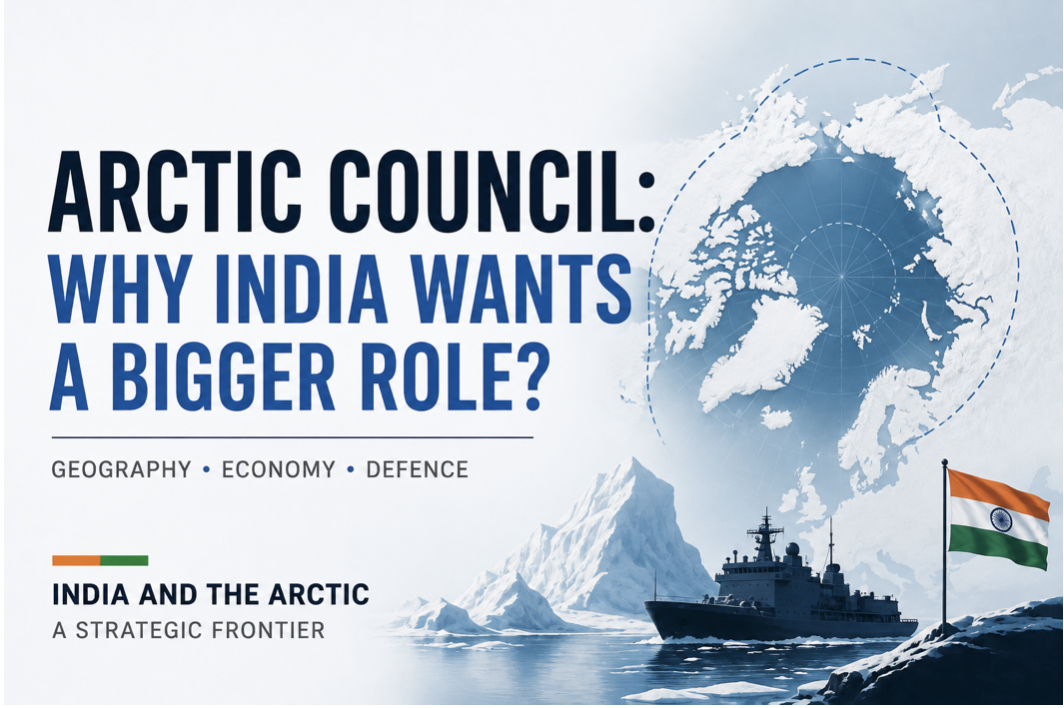
The Arctic is the northernmost polar region of the Earth, surrounding the North Pole. It lies north of the Arctic Circle (66°33′ North latitude), although scientists sometimes define the Arctic using climatic and ecological criteria such as the 10°C July isotherm, tree line, permafrost extent, or sea ice coverage.
Why is the Arctic in the News?
Recently, the Parliamentary Standing Committee on External Affairs recommended that India should:
Seek full-fledged membership of the Arctic Council whenever the opportunity arises.
Appoint a dedicated Polar Ambassador to strengthen India's polar diplomacy.
Expand its Arctic Policy beyond scientific research to include geopolitics, strategic affairs, trade, critical minerals and maritime security.
Increase cooperation with other Asian observer countries such as Japan, South Korea and Singapore.
These recommendations reflect an important shift in India's Arctic engagement—from science-led participation to strategic and economic involvement.
Understanding the Arctic Region
The Arctic is the northernmost polar region of the Earth, surrounding the North Pole. It lies north of the Arctic Circle (66°33′ North latitude), although scientists sometimes define the Arctic using climatic and ecological criteria such as the 10°C July isotherm, tree line, permafrost extent, or sea ice coverage.
Unlike Antarctica, which is a continent covered by thick ice sheets, the Arctic is primarily an ocean (the Arctic Ocean) surrounded by continents and islands. This fundamental geographical difference explains why the Arctic has permanent human settlements, indigenous communities, and sovereign states, whereas Antarctica has no permanent population.
The Arctic region includes:
Arctic Ocean
Northern Russia
Canada
United States (Alaska)
Greenland (autonomous territory of Denmark)
Norway
Sweden
Finland
Iceland (partly within the Arctic region)
What Defines the Arctic?
There are multiple ways to define the Arctic.
The most common definition is based on the Arctic Circle, located at 66°33′ North Latitude.
However, scientists also define it using:
Temperature (July temperature below 10°C)
Tree line
Permafrost extent
Sea ice distribution
Why is the Arctic So Important?
For centuries, the Arctic remained isolated because of:
Permanent sea ice
Harsh climate
Difficult navigation
However, climate change is transforming the region rapidly.
The Arctic is warming nearly four times faster than the global average, a phenomenon known as Arctic Amplification. As sea ice melts, the region is becoming increasingly accessible, making it one of the world's most strategically important frontiers.
Today, the Arctic has emerged as a major arena for:
Climate research
Energy security
Maritime trade
Critical minerals
Great-power competition
Military strategy
What is the Arctic Council?
The Arctic Council is the premier intergovernmental forum responsible for promoting cooperation among Arctic countries on issues related to:
Environmental protection
Sustainable development
Scientific research
Indigenous communities
Climate change
It is not a military or security alliance.
The Council was established through the Ottawa Declaration (1996).
Member Countries of the Arctic Council
The Council consists of eight Arctic States:
Canada
Denmark (through Greenland)
Finland
Iceland
Norway
Russia
Sweden
United States
These countries possess sovereign territory within the Arctic and take all major decisions by consensus.
Observer Countries
Several non-Arctic countries participate as Observers.
India became an Observer State in 2013.
Other major observers include:
China
Japan
South Korea
Singapore
Germany
France
United Kingdom
Italy
Observer countries:
Participate in scientific cooperation.
Attend meetings.
Contribute to Working Groups.
However, they cannot vote or directly shape Council decisions.
Why is the Arctic Becoming Increasingly Important?
1. Climate Change Hotspot
The Arctic is warming much faster than any other region.
Consequences include:
Rapid melting of glaciers.
Shrinking sea ice.
Permafrost thawing.
Rising sea levels.
Changes in global atmospheric circulation.
Scientists increasingly believe that changes in the Arctic influence weather patterns across the Northern Hemisphere.
2. Massive Natural Resources
According to the US Geological Survey (USGS), the Arctic contains approximately:
13% of the world's undiscovered oil
30% of undiscovered natural gas
It is also rich in:
Rare Earth Elements (REEs)
Nickel
Cobalt
Copper
Zinc
Lithium
Graphite
Uranium
These resources are essential for:
Electric vehicles
Semiconductors
Renewable energy
Defence technologies
3. New Shipping Routes
One of the biggest consequences of Arctic ice melt is the opening of new maritime routes.
Major routes include:
Northern Sea Route (NSR)
Runs along Russia's Arctic coast.
Northwest Passage
Passes through the Canadian Arctic.
Transpolar Sea Route
May become navigable later this century.
These routes can significantly reduce travel time between Europe and Asia, lowering transportation costs and fuel consumption.
Arctic Geography and India's Interests
At first glance, the Arctic appears geographically distant from India.
However, geographical processes are interconnected.
Changes occurring in the Arctic influence:
Indian monsoon
Himalayan glaciers
Sea-level rise
Ocean circulation
Extreme weather events
Thus, understanding the Arctic is important even for tropical countries.
How Does Arctic Melting Affect India?
Scientists have found multiple links between Arctic warming and India's climate.
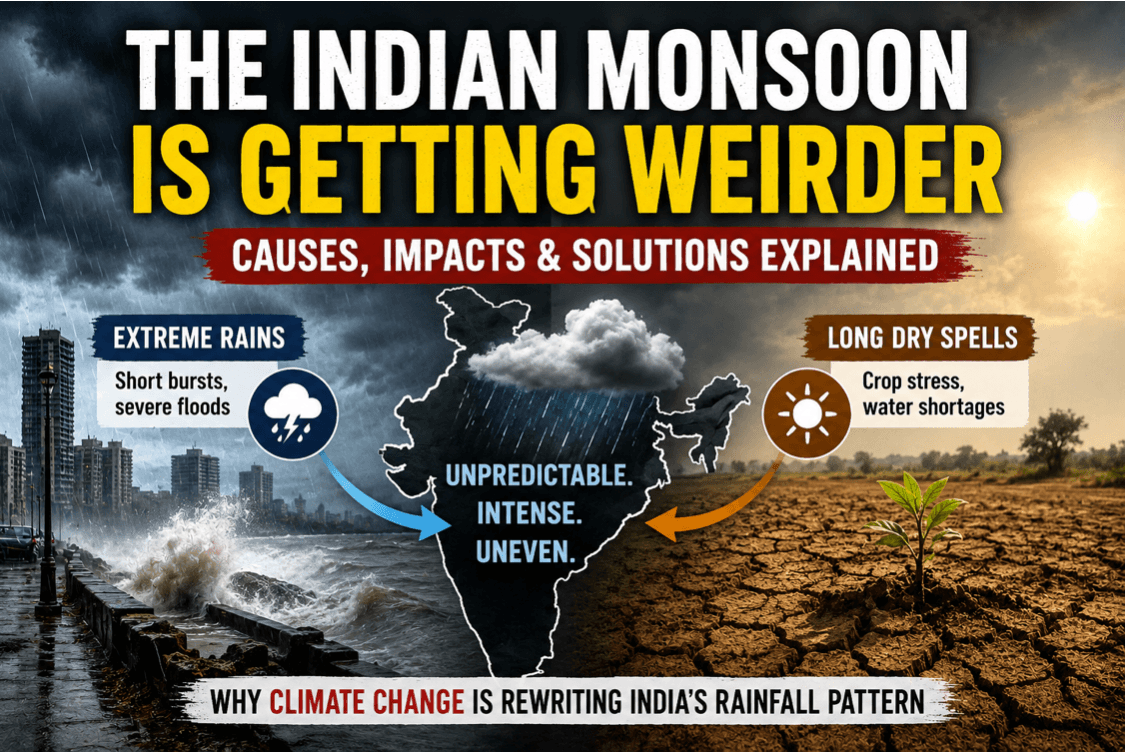
1. Indian Monsoon
Studies by India's National Centre for Polar and Ocean Research (NCPOR) indicate that Arctic warming affects:
Jet Streams
Rossby Waves
Atmospheric circulation
These changes can increase the variability and unpredictability of the Indian Summer Monsoon (ISM).
2. Himalayan Cryosphere
Climate interactions between the Arctic and Himalayas influence:
Snowfall
Glacier melting
River discharge
This has long-term implications for India's water security.
3. Sea-Level Rise
Melting Greenland Ice Sheet contributes significantly to global sea-level rise.
This threatens:
Mumbai
Chennai
Kolkata
Kochi
and other low-lying coastal areas.
India's Arctic Journey
India's engagement with the Arctic has steadily expanded over the past century.
Timeline
1920 – India became a signatory to the Svalbard Treaty.
2007 – First Arctic scientific expedition.
2008 – Establishment of Himadri Research Station in Svalbard.
2013 – India obtained Observer Status in the Arctic Council.
2022 – India released its first Arctic Policy.
2026 – Parliamentary Committee recommended expanding India's Arctic role.
India's Arctic Policy (2022)
India's Arctic Policy rests on six pillars:
1. Scientific Research- Strengthening polar science and international collaboration.
2. Climate & Environmental Protection- Studying Arctic climate impacts on India.
3. Economic & Human Development- Exploring sustainable economic opportunities.
4. Transportation & Connectivity- Promoting Arctic shipping routes.
5. Governance & International Cooperation- Enhancing India's diplomatic engagement.
6. National Capacity Building- Developing expertise in polar sciences.
Why Does India Want a Bigger Role?
India's interest is no longer limited to scientific research.
Its objectives now extend to geography, economy, energy security and geopolitics.
Economic Significance for India
1. Energy Security
India imports over 85% of its crude oil.
The Arctic's vast reserves of:
Oil
Natural gas
can help diversify India's energy sources.
2. Critical Minerals
The Arctic possesses abundant reserves of:
Lithium
Nickel
Cobalt
Rare Earth Elements
These are crucial for:
Electric vehicles
Defence manufacturing
Electronics
Renewable energy
As India seeks to reduce dependence on imports, access to Arctic critical minerals becomes strategically important.
3. Northern Sea Route (NSR)
The Northern Sea Route could transform global trade.
Compared to the traditional Suez Canal Route, NSR can:
Reduce travel distance by nearly 30–40%.
Save approximately 10–15 days of transit time.
Lower fuel costs.
Reduce carbon emissions.
India is already cooperating with Russia to develop infrastructure linked to the NSR and the Chennai–Vladivostok Maritime Corridor.
4. Blue Economy
The Arctic offers opportunities in:
Fisheries
Marine biotechnology
Ocean research
Sustainable shipping
Defence and Geopolitical Importance
The Arctic is increasingly becoming a theatre of strategic competition.
Russia
Russia possesses:
Largest Arctic coastline.
Nuclear submarine bases.
Icebreaker fleet.
Military infrastructure.
United States
The US considers the Arctic central to:
Missile defence.
Homeland security.
NATO strategy.
China
Although not an Arctic country,
China describes itself as a "Near-Arctic State."
Its Polar Silk Road initiative aims to integrate Arctic shipping routes into the Belt and Road Initiative (BRI).
NATO Expansion
With Finland and Sweden joining NATO, the Arctic has acquired greater military significance.
Why Does This Matter for India?
Although India has no territorial claims in the Arctic, developments there affect:
Energy security
Global trade routes
Supply chains
Defence partnerships
Strategic competition
A stronger Arctic presence enables India to safeguard its long-term strategic interests.
Why Does India Want Greater Representation?
The Parliamentary Committee believes India should:
Appoint a Polar Ambassador.
Expand Arctic diplomacy.
Participate more actively in Arctic governance.
Strengthen collaboration with Japan, South Korea and Singapore.
Pursue eventual full membership if the Council expands.
A dedicated Polar Ambassador would improve coordination across:
Science
Diplomacy
Climate negotiations
Strategic partnerships
Challenges Before India
Despite growing engagement, India faces several challenges.
Observer countries have no voting rights.
Increasing rivalry among major powers complicates Arctic diplomacy.
Russia-West tensions have slowed Arctic Council activities.
Limited infrastructure for long-term Arctic operations.
Balancing economic interests with environmental sustainability.
The Way Forward
India's Arctic engagement should gradually evolve from science-driven diplomacy to comprehensive strategic engagement.
Key priorities include:
Expanding scientific research.
Strengthening partnerships with Arctic states.
Developing expertise in polar technology.
Investing in Arctic shipping.
Securing access to critical minerals.
Participating actively in Arctic governance.
Balancing economic development with environmental conservation.
Conclusion
The Arctic is no longer a distant frozen wilderness. It has emerged as one of the world's most strategically important regions due to climate change, resource wealth, emerging shipping routes and great-power competition.
For India, the Arctic is directly linked to monsoon variability, energy security, critical minerals, maritime trade and geopolitical interests. As the region undergoes rapid transformation, India's evolving Arctic policy reflects a shift from scientific curiosity to strategic necessity.
Strengthening India's role in the Arctic—through enhanced diplomacy, scientific cooperation and economic partnerships—will be crucial in protecting its long-term national interests while contributing to sustainable governance of one of Earth's most fragile ecosystems.