The Indian Monsoon is Getting 'Weirder': Why Climate Change is Rewriting India's Rainfall Pattern
For over 150 years, India has maintained systematic records of the southwest monsoon. Throughout this period, one pattern remained remarkably consistent: the monsoon generally arrived in early June, spread rainfall across the country over nearly four months, and began withdrawing in late September.
Why is the Monsoon in the News?
For over 150 years, India has maintained systematic records of the southwest monsoon. Throughout this period, one pattern remained remarkably consistent: the monsoon generally arrived in early June, spread rainfall across the country over nearly four months, and began withdrawing in late September.
Today, that rhythm is changing.
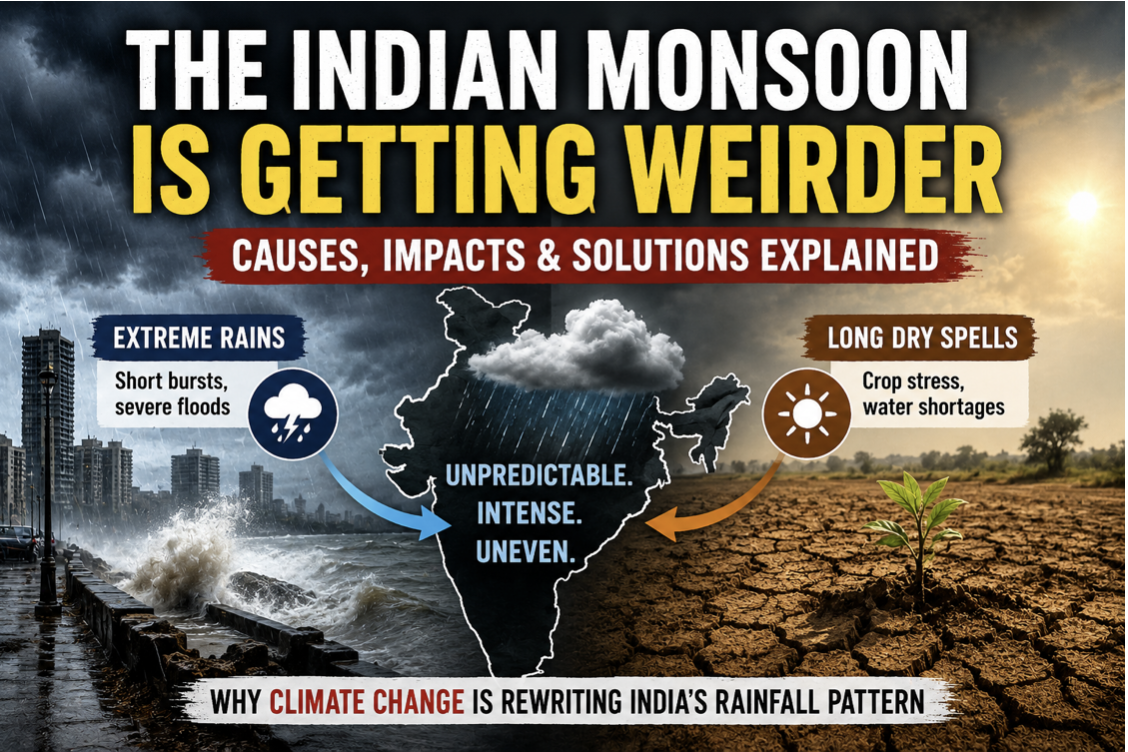
The total rainfall received during the season may still remain close to the long-term average in many years, but when, where, and how it falls has become increasingly unpredictable. Instead of a steady distribution of rainfall, India is witnessing short spells of extremely heavy rain, followed by long dry periods.
Meteorologists now argue that the distribution of rainfall matters more than the seasonal total, making the Indian monsoon one of the clearest indicators of climate change.
India's Monsoon: From Predictable to Unpredictable
Historically, the Indian monsoon followed a relatively stable seasonal cycle.
For centuries, this predictability shaped:
Agricultural calendars
Trade routes
River-based civilizations
Food security
Rural livelihoods
The famous Indian Ocean trade even depended on monsoon winds. Merchants from Gujarat sailed towards Arabia and East Africa during one phase of the monsoon and returned when the winds reversed.
Today, however, the monsoon is no longer behaving in its traditional manner.
The India Meteorological Department (IMD) increasingly observes that rainfall is becoming:
More intense
More localized
More erratic
Less evenly distributed
In simple terms, India is receiving nearly the same rain—but in a completely different way.
The "Weirdness" of the Indian Monsoon: A Data-Driven Picture
Scientists describe the present monsoon as becoming "flashier"—characterised by intense rainfall events separated by prolonged dry spells.
Several recent examples highlight this shift.
Mumbai
Traditionally:
Monsoon begins around 10 June
Withdrawal starts in late September
Recent pattern:
Rainfall started as early as May
Continued into October
In another year, almost the entire month's rainfall occurred within the first week of July
Instead of steady rain over four months, Mumbai experienced concentrated bursts causing severe flooding.
Gujarat
Historically regarded as a relatively dry state, Gujarat has recently witnessed:
Extremely heavy cloudbursts
Very high rainfall over a few days
Long dry intervals between rainfall events
Such rainfall patterns increase both flooding and water scarcity simultaneously.
Bihar
In contrast, parts of Bihar experienced:
Long rainless periods
Delayed sowing
Moisture stress for crops
Even though the country's overall monsoon may remain "normal," local rainfall deficits can seriously affect agriculture.
Assam
Assam recorded nearly a 30% seasonal rainfall deficit, yet experienced devastating floods.
This seemingly contradictory situation occurs because:
Rain falls within very short periods.
Rivers overflow rapidly.
Remaining weeks remain unusually dry.
Thus, less total rainfall does not necessarily mean fewer floods.
The New Normal: Fewer Rainy Days, More Extreme Rainfall
Several scientific studies indicate a common trend across India.
The changing rainfall pattern
Total seasonal rainfall has not declined dramatically.
The number of rainy days is decreasing.
Heavy rainfall events are becoming more frequent.
Dry spells between rain events are becoming longer.
Localized cloudbursts are increasing.
Rainfall variability is rising across regions.
This phenomenon is often described as "less frequent but more intense rainfall."
Why is the Monsoon Becoming Weirder?
The biggest driver behind these changes is climate change.
Global warming is altering the delicate balance between the Indian Ocean, Indian landmass, and the atmosphere that drives the southwest monsoon.
Scientists now consider the Indian Ocean to be one of the fastest warming ocean basins in the world.
This has profound consequences for India's rainfall.
How Does the Indian Monsoon Normally Work?
Understanding the changing monsoon first requires understanding its normal mechanism.
Step 1: Differential Heating
During April and May:
The Indian landmass heats rapidly.
The surrounding Indian Ocean remains comparatively cooler.
This creates a low-pressure area over the Indian subcontinent.
Step 2: Moisture Transport
Moisture-laden winds from the:
Arabian Sea
Bay of Bengal
move towards the low-pressure zone over India.
Step 3: Orographic Rainfall
When these winds encounter mountain barriers like:
Western Ghats
Himalayas
they rise, cool and condense, producing rainfall.
This seasonal circulation forms the Southwest Monsoon.
How Climate Change is Altering this Mechanism
Although the basic circulation remains intact, global warming is changing several components of the monsoon system.
1. Rapid Warming of the Indian Ocean
The Indian Ocean is warming faster than before.
Warmer oceans increase:
Evaporation
Atmospheric moisture
Since warm air can hold nearly 7% more moisture for every 1°C rise in temperature (Clausius–Clapeyron relationship), storms now release much heavier rainfall when conditions become favourable.
2. Reduced Land-Sea Temperature Contrast
Interestingly, parts of the Indian landmass have not warmed as rapidly as the surrounding ocean.
As a result:
Pressure difference between land and sea weakens.
Monsoon winds become relatively weaker.
Moisture transport becomes more irregular.
This contributes to delayed onset and prolonged dry spells.
3. More Atmospheric Instability
Higher temperatures create greater atmospheric instability.
Consequences include:
Localized thunderstorms
Cloudbursts
Extreme rainfall events
Sudden flooding
4. Influence of Climate Oscillations
Natural climate phenomena further amplify rainfall variability.
Examples include:
El Niño
La Niña
Indian Ocean Dipole (IOD)
Madden-Julian Oscillation (MJO)
Although these oscillations have always existed, climate change is increasing their impacts on monsoon behaviour.
Impacts of a "Weirder" Monsoon
Agriculture
Agriculture remains the sector most vulnerable to rainfall variability.
Nearly 43% of India's workforce depends on agriculture.
Erratic rainfall affects:
Sowing schedules
Germination
Crop growth
Harvest quality
Farm incomes
Both floods and prolonged dry spells reduce agricultural productivity.
Water Security
Ironically, intense rainfall does not necessarily improve water availability.
During prolonged dry periods:
Soil hardens.
Infiltration declines.
Groundwater recharge reduces.
When heavy rain eventually occurs:
Water quickly flows into rivers.
Less water enters underground aquifers.
Thus, both floods and droughts become more frequent.
Urban Areas
Indian cities are becoming increasingly vulnerable.
Rapid urbanisation has led to:
Encroachment of wetlands
Loss of lakes
Concrete surfaces
Poor drainage systems
As a result:
Short-duration heavy rainfall causes urban flooding.
Transportation networks collapse.
Economic activity is disrupted.
Public health risks increase.
Cities like Mumbai, Bengaluru, Chennai and Delhi have repeatedly experienced this phenomenon.
Economy
A highly variable monsoon affects the broader economy through:
Food inflation
Lower agricultural output
Damage to infrastructure
Higher disaster management costs
Increased insurance claims
Disruption of supply chains
Although irrigation now covers more than half of India's cultivated land, rainfall variability continues to influence overall economic stability.
Ecosystems
Changing rainfall patterns also affect:
Forest regeneration
Wetland ecosystems
River flows
Biodiversity
Wildlife habitats
Frequent floods accelerate soil erosion while prolonged dry spells increase forest fire risks.
Can India Adapt to a Changing Monsoon?
India cannot control the monsoon, but it can improve its resilience.
Several measures have already been initiated.
The India Meteorological Department (IMD) has significantly strengthened:
Doppler Weather Radar network
Automatic Weather Stations
Satellite observations
High-resolution weather forecasting models
The government has also identified drought-prone districts and promoted:
Water conservation
Fodder availability
Climate-resilient crops
However, adaptation must increasingly shift from national planning to local implementation.
The Way Forward
Experts argue that future adaptation should focus on climate resilience rather than climate prediction alone.
Key priorities include:
Agriculture
Climate-smart farming
Drought-resistant crop varieties
Improved crop insurance
Diversification of crops
Water Management
Rainwater harvesting
Aquifer recharge
Watershed development
Efficient irrigation (drip and sprinkler systems)
Urban Planning
Sponge city concepts
Wetland restoration
Improved storm-water drainage
Flood-resilient infrastructure
Disaster Preparedness
Hyper-local weather forecasts
Early warning systems
Community disaster response plans
Climate-risk mapping
Climate Action
Reducing greenhouse gas emissions
Expanding renewable energy
Protecting forests
Restoring natural ecosystems
Conclusion
The Indian monsoon is no longer merely becoming weaker or stronger—it is becoming more unpredictable. The challenge today is not simply how much rain falls, but when, where, and how intensely it falls.
Climate change is fundamentally altering one of Earth's most reliable weather systems, increasing the frequency of extreme rainfall, prolonged dry spells, urban flooding, and agricultural uncertainty.
As meteorologists increasingly note, India's future climate will likely be defined not by the absence of the monsoon, but by its growing variability. Building resilience through better forecasting, climate-smart infrastructure, sustainable water management, and local adaptation will be crucial to safeguarding livelihoods, food security, and economic stability in the decades ahead.